
Never get buffed.
Leave one phrase — your name, a shout, a memory — in a graffiti font on an endless concrete wall. $1. Stays up forever.
Go to the wall →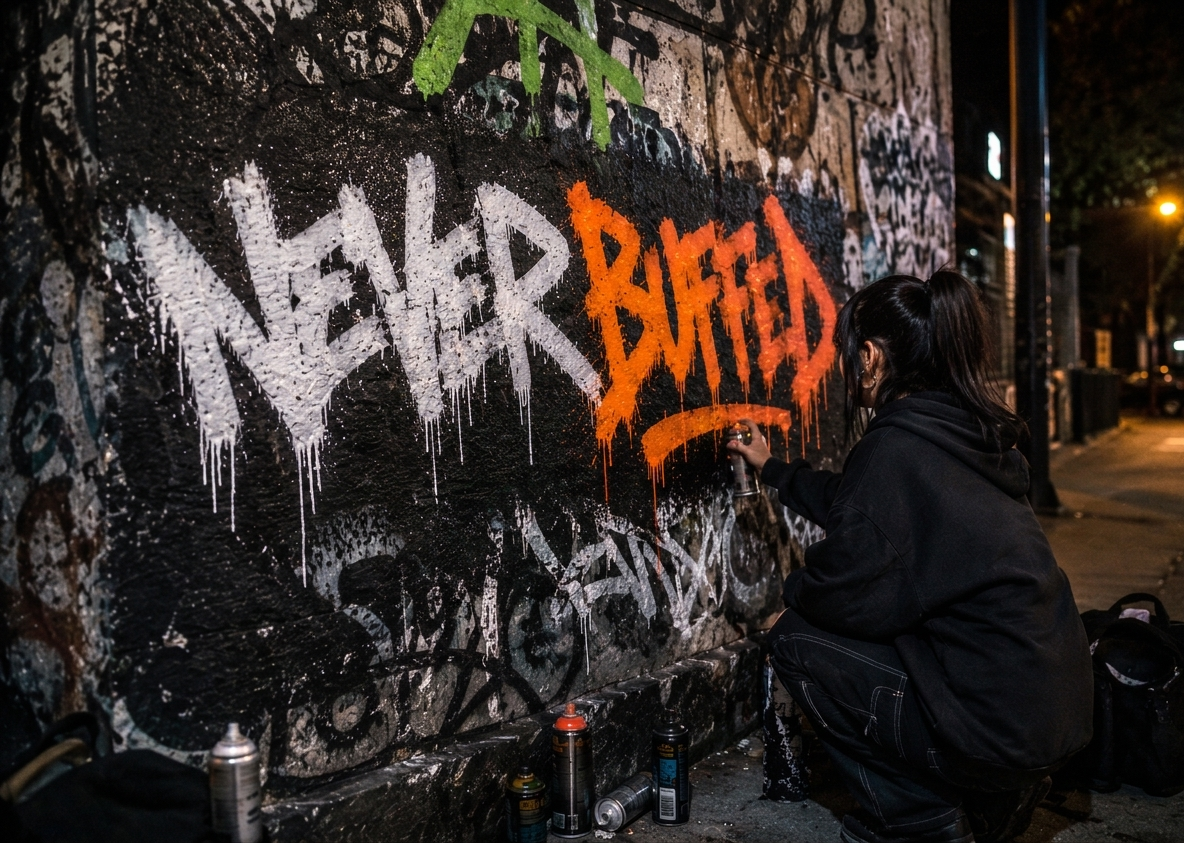
What Is a Tag in Graffiti?
A tag is the simplest, fastest form of graffiti: a writer’s stylized signature. Here’s what a tag is, where the word comes from, and how it’s done.
The short answer
A tag is a graffiti writer’s signature — their name or alias written quickly in a single color, usually with a marker or a can of spray paint. It is the most basic and most common form of graffiti, and almost every writer starts here.
Think of it as a handwritten autograph turned into street art. The whole point is the style of the lettering: the flow, the angles, the loops, and the personal flourishes that make one writer’s name instantly recognizable from another’s.
Where the word comes from
The modern use of “tag” traces back to late-1960s and early-1970s New York and Philadelphia. Early writers like TAKI 183 — a teenager who wrote his nickname and street number all over Manhattan — turned a simple repeated signature into a citywide phenomenon. A 1971 newspaper story about TAKI 183 is often credited with sparking the first big wave of writers chasing the same kind of recognition.
To “get your name up” was the goal, and the name you wrote became your tag.
What makes a good tag
Tags look effortless, but a clean one takes practice. Writers care about:
- Flow — how smoothly the letters connect in one continuous motion.
- Consistency — the same name looking sharp whether it’s on paper or a wall.
- Style — the personal quirks (arrows, loops, dots, swashes) that make it yours.
- Speed — a tag is meant to be quick, so the hand has to know the letters cold.
Tag vs. throw-up vs. piece
A tag is the starting point of a ladder. A throw-up is a bigger, bubble-lettered step up that still goes fast. A full piece (short for masterpiece) is the most elaborate — multiple colors, effects, and time. If you want them side by side, see tag vs. throw-up vs. piece.
Never Buffed is a permanent graffiti wall. Put one line up for $1 — in a graffiti font, kept up forever.
Put your mark on the wall →