
Never get buffed.
Leave one phrase — your name, a shout, a memory — in a graffiti font on an endless concrete wall. $1. Stays up forever.
Go to the wall →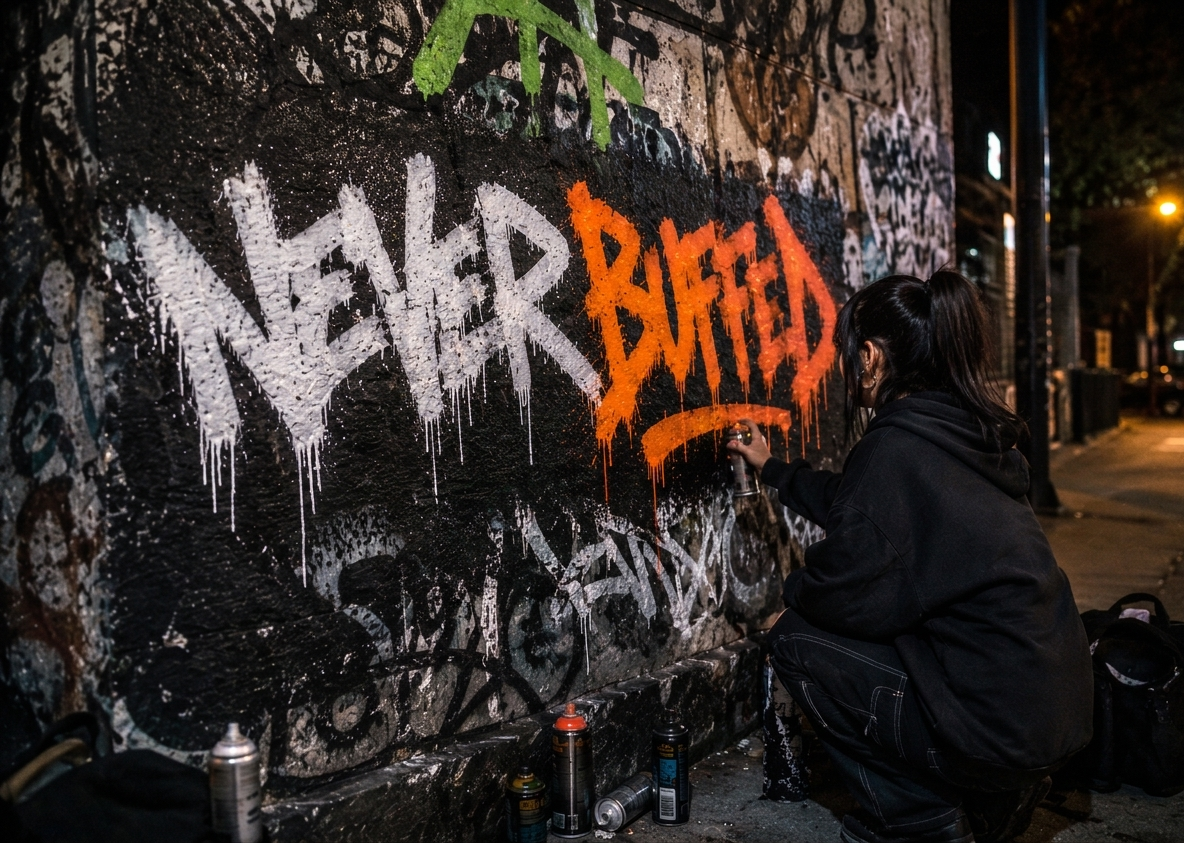
A Short History of Graffiti
From ancient walls to 1970s New York subways and today’s global street art, here’s a short, readable history of modern graffiti.
Writing on walls is ancient
People have written on walls for as long as there have been walls — from carvings in ancient Rome to messages scratched into Pompeii. But graffiti as we know it today — stylized names, spray paint, and a culture around “getting up” — is a much more recent, mostly American story.
New York and Philadelphia, late 1960s–1970s
Modern graffiti took shape in Philadelphia and New York City. Early writers like CORNBREAD in Philadelphia and TAKI 183 in New York spread their names across their cities. A 1971 newspaper article about TAKI 183 helped ignite a wave of teenagers competing to get their tags up everywhere.
New York’s subway system became the canvas. Trains carried names across the whole city, and the competition pushed writers from simple tags to throw-ups and full-color pieces.
Style explodes
Through the 1970s and ‘80s, writers invented the lettering styles still used today — including wildstyle, the dense interlocking form covered in graffiti styles explained. Films, photo books, and the parallel rise of hip-hop carried the culture far beyond New York.
Going global
By the 1990s and 2000s graffiti was worldwide, branching into the broader category of street art and influencing design, fashion, and galleries — even as the classic forms on the street stayed the same. The vocabulary, the ladder of forms, and the drive to leave your name behind all survive. For the slang, see the graffiti slang glossary.
Never Buffed is a permanent graffiti wall. Put one line up for $1 — in a graffiti font, kept up forever.
Put your mark on the wall →